
Brand & Funnel Strategy + Creative Portfolio
A complete strategy document with persona, funnel, channel mix and a six-month roadmap, plus 15 designed assets — ad banners, carousels, thumbnails, brochures and a brand kit.
- Photoshop
- Canva Pro
Every core digital marketing channel covered with maximum hands-on practice and no AI shortcuts — 25 certifications, ten portfolio projects and a 15–20 day live industry project on a real business account, all in six months.
techcadd’s classical digital marketing programme: six months, 250 to 260 hours of classroom and supervised lab time, 25 certification exams (22 free), 10 portfolio projects and a 15 to 20 day live industry project on a real business account. It covers every core channel and is deliberately taught without AI shortcuts — the promise is manual, first-principles skill in each channel, on the reasoning that you learn to do the work first, which is what makes you able to check AI later.
Key Highlights
techcadd’s classical digital marketing programme: six months, 250 to 260 hours of classroom and supervised lab time, 25 certification exams (22 free), 10 portfolio projects and a 15 to 20 day live industry project on a real business account. It covers every core channel and is deliberately taught without AI shortcuts — the promise is manual, first-principles skill in each channel, on the reasoning that you learn to do the work first, which is what makes you able to check AI later. The first two months build the production skills every other channel depends on. You start with funnel architecture, the customer journey, buyer personas, competitor teardowns, channel-mix planning and the metrics language of the job — CPM, CPC, CTR, CPL, CAC, AOV, LTV, ROAS — producing a one-page strategy document for a live business. Then graphic design for marketers with Photoshop and Canva Pro, ad creative anatomy and a format library; video editing in Premiere Pro and CapCut with the 3-second hook, retention curve and YouTube strategy; and a full website section covering domains, DNS, hosting, cPanel, WordPress, Elementor Pro, a five-page business site, high-converting landing pages and form-to-CRM integration. Month three is the SEO block, and it is unusually complete for a six-month course: keyword research and search intent, on-page optimisation and content quality, technical SEO with crawl budget, canonicals, structured data and a prioritised remediation report, then off-page link building and digital PR. Month four covers local SEO and Google Business Profile — the easiest first freelance retainer to sell — then content marketing and conversion copywriting, and a full social media section across Instagram, Facebook, LinkedIn, YouTube, X and Pinterest, with the mid-term practical at the end of it. Month five is paid media: Google Ads across Search, Display, Shopping, Performance Max and YouTube, then Meta Ads from Business Manager, Pixel and Conversions API through audience strategy, creative testing frameworks, scaling and click-to-WhatsApp funnels for Indian SMEs. Month six closes the programme with e-commerce store builds on WooCommerce and Shopify, conversion rate optimisation and cart recovery, email marketing with CRM and lifecycle automation, GA4, Google Tag Manager and Looker Studio, then freelancing and agency building, project management and interview preparation — alongside the live industry project: 15 to 20 working days of supervised work on a real business account, assessed and separately certified.
Every module ends in something you have built and a trainer has reviewed, so the list below is work you will have done rather than topics you will have heard about.
a Google Ads build with Shopping and conversion tracking, and a full-funnel Meta build
The syllabus is arranged so every module produces an asset rather than a set of notes. You will cover month 1 — strategy & creative production, month 2 — video & website development, month 3 — the full seo stack, month 4 — local seo, content & social, and finish with a live project built on Photoshop & Canva Pro, Premiere Pro & CapCut, WordPress, Elementor Pro & cPanel. Modules run in the order a real project runs: foundations first, then the core skills, then applied work under supervision, then the portfolio and interview preparation that turn all of it into an offer letter.
The working knowledge the job description actually lists.
Month 3 — The Full SEO Stack
Keyword research, on-page, technical and off-page — in depth, not as an overview.
4 weeks · 24 sessions
Topics covered
The toolchain
Everything below is installed on the lab machines and used on live client work, not shown once in a slide and forgotten.
Any stream, no marketing background. The course begins at what digital marketing is and how a funnel works, and the level runs from beginner to complete digital marketer.
This track teaches every channel by hand. If you would rather understand why a campaign works before letting a tool suggest it, this is the deliberate choice — and it is what makes you able to check AI output later.
Design, video, web, the full SEO stack, local SEO, content, social, Google Ads, Meta Ads, e-commerce, CRO, email, CRM and analytics — all covered across six months.
The freelancing block covers positioning, pricing, proposals, contracts, invoicing, GST basics and client acquisition. The web build alone sells for ₹15,000 – ₹60,000 a project, and most students earn their first income before placement.
Morning, afternoon, evening and weekend batches all run, classes are 1.5 to 2 hours a day, and missed sessions are repeated with another batch.
25 exams, 22 of them free, each mapped into the topic covered before it and attempted in a supervised lab slot, with badges added to your LinkedIn and CV with verification links.
Every business in this region is now buying advertising, and the people who can produce the creative, build the site, rank it, run the ads and prove the result are the ones agencies keep rather than replace. That gap is the whole argument for this course: there is local demand, there are budgets, and there are very few trained people to hand the work to.
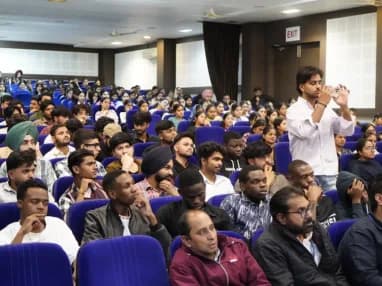
Build skills that hold up beyond the classroom.
What separates this from a playlist of tutorials is supervision on real work. From the second half of the course you build on live client projects with a trainer beside you, make decisions that have consequences, and correct them the following week. That loop is the skill. No employer in Phagwara will take your word for it without work they can inspect.
Be realistic about the money. A fresher who finishes with a working portfolio starts near the bottom of the band and moves quickly; someone who finishes with a certificate and nothing to show does not. The difference is entirely what you built.
The alternative is what most people try first: free videos, a cheap online course, six months of drifting, and knowledge you cannot demonstrate. A structured programme with live projects, a mentor who corrects you, an internship letter and a placement cell that actually calls employers is the difference between knowing the subject and being hired to do it.
Students reach the Phagwara centre from Banga, Nakodar, Kartarpur and the university belt, and the weekend batch exists so a job or a degree does not have to be paused to attend.
Across Google, Meta, Microsoft, HubSpot, SEMrush, Ahrefs, Adobe, Canva, Yoast, BrightLocal, LinkedIn and Shopify — each mapped into the topic covered before it.
Strategy deck, design portfolio, video pack, live website, SEO case study, social operation, two live ad accounts, a store with automation, and an analytics dashboard.
Supervised work on a real business account covering strategy, execution, optimisation and client reporting — separately assessed and separately certified.
Keyword research, on-page, technical and off-page covered in depth — including audits and remediation reports that agencies sell as standalone projects.
No AI shortcuts. You learn to do the work first, which is what makes you able to check AI later — and what makes the skill portable when the tools change.
Hosted portfolio, rebuilt LinkedIn with certification badges, proposal templates and pricing sheets, plus Upwork and Fiverr profile setup.
Complete the course with a portfolio of live projects and receive an industry-recognised certificate, plus a documented internship letter accepted by Punjab universities.
Recognised by employers across Punjab and beyond
Based on real client work, not a simulation
Live work you can show in any interview
CV review, mock interviews and hiring drives
Two certificates on completion — the course certificate and a separate capstone project certificate.
The roles this opens, what they pay in Punjab and beyond, and who is hiring for them — drawn from published job-market listings, not a brochure number.
The generalist entry role across channels. Indicative fresher range for North India: ₹2.4 – 4.2 LPA.
Organic search in depth — audits, on-page, technical and links. Indicative fresher range: ₹2.2 – 4.2 LPA.
Paid media judged on cost per acquisition and ROAS. Indicative fresher range: ₹2.8 – 4.8 LPA, the highest of these entry titles.
Calendar, creative and community across six platforms. Indicative fresher range: ₹2.2 – 3.8 LPA.
Store operations, feeds, CRO and cart recovery on WooCommerce or Shopify. Indicative fresher range: ₹2.4 – 4.2 LPA.
Indicatively ₹15,000 – ₹50,000 a month. The web build alone sells for ₹15,000 – ₹60,000 a project, and most students earn their first income before placement.
Salary outlook — Digital Marketing Executive
Runs the channels a business grows on. These are market observations, not guarantees — actual offers vary by city, company, portfolio strength and interview performance.
Indicative ranges compiled from public job-market listings. Actual offers vary by employer, skillset and interview performance.
A complete strategy document with persona, funnel, channel mix and a six-month roadmap, plus 15 designed assets — ad banners, carousels, thumbnails, brochures and a brand kit.
Five edited short-form videos with hooks, captions and platform-native formatting, then a live WordPress business site plus a dedicated conversion landing page.
A full audit, on-page implementation, link plan and eight-week rank tracking on a live site, delivered as an SEO case study.
A 30-day content calendar executed on a real handle across multiple platforms, delivered with growth analytics.
Search, Display and Shopping campaigns with a Merchant Center feed and conversion tracking; and a full-funnel Meta build with Pixel, CAPI, lookalikes and retargeting.
A WooCommerce store with automated welcome, cart-recovery and win-back flows and a blended Looker Studio dashboard — then 15 to 20 days of supervised work on a real business account, presented to a review panel.
Every project moves through the same loop: understand the brief, build with guidance, then explain the decisions behind your work.
Take a real requirement apart before touching a tool — what is being asked, what it needs, and which part to build first.
Brand & Funnel Strategy + Creative Portfolio
Work hands-on with your trainer watching the screen, so a wrong turn is caught in the same session rather than three weeks later.
Video Reel Pack & Live Website
Walk through what you built and why you built it that way. This is the interview rehearsal, run against every project rather than once at the end.
SEO Campaign
There are many places to learn this in Phagwara and the brochure syllabus looks similar at all of them. What differs is who teaches, whether you ever touch real work, and whether anyone picks up the phone after you have paid. techcadd has trained students across Punjab since 2007 on the same model: small batches, working practitioners as trainers, client projects as coursework.
Each exam’s published topic list is mapped into the class content before it, so what you study is the syllabus. Attempts happen in scheduled supervised lab slots of roughly two hours.
You build the thing before you read about it. Students who have actually done the task answer scenario questions correctly; students who only read about it do not.
Most exams allow retakes after a short cooldown. If you fail, your weak domains are reviewed and you are rebooked. Failing an attempt is normal and carries no penalty from the institute.
Google and Meta credentials expire after 12 months. You are taught the renewal process so your stack does not quietly lapse after you leave.
Attendance 10%, assignments 25%, mid-term practical 15%, portfolio projects 20%, live project 20%, final viva and mock interview 10% — with a published rubric and one free re-attempt of any failed component.
A hosted portfolio with every project, live URL and badge; ATS-optimised CV and LinkedIn; technical, case-study and HR mock interviews with written feedback; profile circulation across Punjab, Chandigarh, Delhi NCR and remote roles; plus continued job postings and refresher classes.
Find answers to the questions students ask before enrolling.
Six months, 250 to 260 hours of classroom and supervised lab time. Classes run 1.5 to 2 hours a day, five to six days a week, with morning, afternoon, evening and weekend batch options. It is offline classroom teaching with one workstation per student, premium tool access during the course, backup classes for missed sessions, doubt-clearing hours and a mentor group.
Send your question and a counsellor will call you back about batch timings, fees, EMI options, placement record, or whether this course fits your degree.
One call with a counsellor is usually enough to find out. Book a free demo class and see the lab before you decide.