

Containerised API Service
A FastAPI service backed by PostgreSQL, typed with Pydantic and tested, shipped in Docker with CI running on every push — the foundation every later agent is built on.
- FastAPI
- Docker
Learn Agentic AI in Phagwara — build LLM agents that plan, call tools and finish multi-step work with LangGraph & MCP, on live projects with placement support.
25,000+
Students trained
since 2007
4.9★
Google rating
556+ reviews
100%
Practical training
live client work
Agentic AI is software that pursues a goal instead of answering one prompt. A language model replies; an agent decides what to do next — it plans a step, calls a real tool such as an API, a database or a browser, reads the result and goes again until the job is done, the budget is spent or a human must approve. Techcadd’s Agentic AI Course in Phagwara teaches you to build, evaluate, secure and operate exactly those systems. The syllabus is a thirty-three-module ladder with exit points at three, six and nine months. The first stage starts at Python from the first line, so no programming background is assumed, then covers prompting and structured output, tool calling and the Model Context Protocol, retrieval-augmented generation with citations, memory and state, graph orchestration with human-in-the-loop approval, then evaluation, guardrails and a deployed capstone. The six-month stage adds async engineering, model routing, production MCP gateways, GraphRAG, durable execution, multi-agent systems, red teaming and Kubernetes deployment. The nine-month stage moves from building an agent to owning the platform — ingestion pipelines, vector infrastructure, evaluation as a service, fine-tuning, voice agents and governance. Every module ends in a graded artefact reviewed by a trainer who ships this work for clients, and you leave the Phagwara centre with agents you can explain end to end.

The Agentic AI course is built for people at six different starting points, and the batch is deliberately mixed. What matters far more than your background is turning up consistently and finishing what each module asks you to build.
Module 01 starts at Python from the first line, so nothing is assumed. Most students run the 3-month Practitioner stage alongside a degree at LPU, GNA University or Kamla Nehru College using the weekday or weekend batch, and extend later if it takes.
A college project rarely gets an interview on its own. A published MCP server, a cited RAG assistant and a deployed agent with an evaluation report do — and the internship letter counts towards your industrial training requirement.
If you already write Python or JavaScript, the first module is a fast revision and everything after it is new. The weekend batch lets you move from web or backend work into AI engineering without leaving your current job.
Immigration consultancies, export houses, schools and hospitals along the GT Road all have repetitive multi-step work an agent could take on. Learn enough to build the first one yourself, or to judge properly what a vendor is selling you.
Agent builds are billed remotely, so a Phagwara address costs you nothing on a brief from Delhi, Dubai or Canada. The programme covers scoping, evaluation evidence and cost-per-task reporting, which is how you defend a price rather than just quote one.
If tutorials left you with notes but nothing running, what changes here is a graded deliverable at the end of every module and a trainer who reviews what you produced this week. A gap on the CV matters less than a deployed agent you can demonstrate.
Businesses across Punjab are moving their AI budgets from chatbots that answer to agents that actually complete work, and there are very few people in the Doaba region who can build one, prove it works and keep it running safely. That gap is the whole argument for this course: there is local demand, there are budgets, and there are very few trained people to hand the work to.

Build skills that hold up beyond the classroom.
What separates this from a playlist of tutorials is supervision on real work. From the second half of the course you build on live client projects with a trainer beside you, make decisions that have consequences, and correct them the following week. That loop is the skill. No employer in Phagwara will take your word for it without work they can inspect.
Be realistic about the money. A fresher who finishes with a working portfolio starts near the bottom of the band and moves quickly; someone who finishes with a certificate and nothing to show does not. The difference is entirely what you built.
The alternative is what most people try first: free videos, a cheap online course, six months of drifting, and knowledge you cannot demonstrate. A structured programme with live projects, a mentor who corrects you, an internship letter and a placement cell that actually calls employers is the difference between knowing the subject and being hired to do it.
Students reach the Phagwara centre from Banga, Nakodar, Kartarpur and the university belt, and the weekend batch exists so a job or a degree does not have to be paused to attend.
Thirty-three modules in a single numbered sequence. Leave at three months with a deployed agent, at six as an engineer who can run one in production, or at nine as someone who can design the platform. A shorter track costs you scope, never depth.
Most agentic AI courses quietly require a developer. Module 01 teaches Python, the command line, Git, HTTP and SQL from nothing, and everything after it assumes only what you built there.
Anyone can show an agent that works once. Half the grading weight sits on a labelled evaluation set, a measured before-and-after, a red-team result and a cost-per-task number — because that is what a hiring manager asks for.
Frameworks change every quarter; tool calling, retrieval, state, evaluation and guardrails do not. You learn LangGraph, MCP, Qdrant and RAGAS properly and treat the alternatives as swappable implementations of the same idea.
Any agent that combines private data, untrusted content and the ability to act outward is exploitable. You learn content isolation, least privilege, egress control and human confirmation before irreversible actions — from the first stage, not as an afterthought.
You advance when a deliverable passes review, not when the calendar says so. That is slower for some students and faster for others, and it is why the certificate means something to the employers who know it.
The syllabus is arranged so every module produces an asset rather than a set of notes. You will cover programming foundations — from absolute zero, llm foundations, prompting & structured output, tool calling, function execution & mcp, retrieval-augmented generation & knowledge grounding, and finish with a live project built on Python, LangGraph, LangChain. Modules run in the order a real project runs: foundations first, then the core skills, then applied work under supervision, then the portfolio and interview preparation that turn all of it into an offer letter.
The working knowledge the job description actually lists.
Tool Calling, Function Execution & MCP
The step that turns a model into something that can do work — designing tools, calling them reliably and publishing them over the Model Context Protocol.
2 weeks · 10 sessions
Retrieval-Augmented Generation & Knowledge Grounding
Make an agent answer from your documents rather than its memory, with citations a reviewer can check and a score that proves it.
2 weeks · 10 sessions
Memory, State & Context Management
Give an agent memory that survives a session and stays private to the user it belongs to.
2 weeks · 8 sessions
Topics covered
The Agentic AI course runs as three nested levels. Each one builds on the last, so you can start at the foundation and continue later without repeating anything.
Start from no programming experience and finish with a deployed agent, a published MCP server and a cited RAG assistant — Modules 01 to 07 of the ladder.
What it covers
Skills & tools
Recommended for
Agent Developer, AI Automation Engineer, Solutions Engineer and junior AI developer roles.
Everything in the Practitioner stage, then Modules 08 to 20 — the engineering that turns a working demo into a system a business can rely on.
What it covers
+ 5 more
Skills & tools
Recommended for
AI Engineer, LLM Application Developer, RAG Engineer and AI Platform Engineer roles.
Both earlier stages, then Modules 21 to 33 — from building one agent to designing, securing and governing the platform an organisation runs them on.
What it covers
+ 5 more
Skills & tools
Recommended for
Agentic AI Architect, Staff AI Engineer, AI Platform Engineer and Head of AI Engineering pathways.
Python programming from zero
LLM APIs & structured output
Tool calling & MCP servers
Retrieval-augmented generation
Memory & state management
LangGraph orchestration & human-in-the-loop
Evaluation, guardrails & deployment
Async engineering & model routing
Production MCP gateways
GraphRAG & advanced retrieval
Durable & multi-agent orchestration
Browser & coding agents
Red teaming & agent security
Kubernetes deployment & cost engineering
Data pipelines & vector infrastructure at scale
Fine-tuning & RL post-training
Voice & multimodal agents
Agent platform, governance & FinOps
The programme is nested, not parallel. The 3-month Practitioner track covers Modules 01 to 07 and ends with a deployed agent. The 6-month Engineer track contains all of that and continues from Module 08 into production engineering, security and scale. The 9-month Architect track contains both and continues from Module 21 into platform design, post-training and governance — so choosing a shorter track costs you scope, never depth, and you can extend later without repeating a single module.
The toolchain behind the craft
Everything below is installed on the lab machines and used on live client work, not shown once in a slide and forgotten.
Complete the course with a portfolio of live projects and receive an industry-recognised certificate, plus a documented internship letter accepted by Punjab universities.
Recognised by employers across Punjab and beyond
Based on real client work, not a simulation
Live work you can show in any interview
CV review, mock interviews and hiring drives
Two certificates on completion — the course certificate and a separate capstone project certificate.
The roles this opens, what they pay in Punjab and beyond, and who is hiring for them — drawn from published job-market listings on one comparable scale, not a brochure number.
Salary outlook
Builds, evaluates and operates LLM agents that call tools, retrieve from company data and complete multi-step work. Earnings depend on your portfolio, evaluation evidence, production experience, employer and location.
Punjab — AI Agent Developer
Delhi / NCR — AI Engineer
Remote / Freelance Agent Work
Indicative ranges for AI Agent Developer roles, compiled from public job-market listings and drawn on the same scale in every market. Actual offers vary by employer, skillset and interview performance — Punjab pay typically reaches 2× the fresher ceiling within two years of delivery experience.
Talk about your target roleThe three-month stage prepares you for Agent Developer, AI Automation Engineer and Solutions Engineer roles. The six-month stage prepares you for AI Engineer, LLM Application Developer, RAG Engineer and AI Platform Engineer. The nine-month stage prepares you for Agentic AI Architect and staff-level AI engineering. Each level is interviewed differently — reliable tool wiring and a deployed demo early on; evaluation, cost control and incidents in the middle; system design, threat modelling and total cost of ownership at architect level.
A fresher with a working, deployed portfolio starts around ₹25,000 – ₹50,000 a month in the Punjab market and reaches ₹50,000 – ₹1,00,000 with two years of delivery experience. Delhi/NCR runs materially higher, from ₹35,000 – ₹70,000 for a fresher to ₹80,000 – ₹1,60,000+ after two years.
Yes, and it is one of the most remote-friendly skills in the catalogue. Freelance agent work starts lower, around ₹20,000 – ₹45,000 a month, because income ramps rather than starting at a salary, but it reaches ₹70,000 – ₹1,80,000+ once you have delivered real builds. The programme covers scoping, evaluation evidence and cost reporting so you can price and defend the work.
IT services and product companies adding agent features, AI startups, consulting and automation firms, and — increasingly — the immigration consultancies, schools, hospitals, export houses and real-estate firms around Phagwara, Jalandhar and Kapurthala that have repetitive multi-step work worth automating. Remote clients in Delhi, Dubai and Canada make up a large share on top.
No. Module 01 teaches Python from the first line, along with the command line, Git and GitHub, HTTP and REST, and SQL, and ends with a containerised FastAPI service with tests passing in CI. Everything after it assumes only that, which is why the programme is open to graduates from any stream and to career changers.
A FastAPI service backed by PostgreSQL, typed with Pydantic and tested, shipped in Docker with CI running on every push — the foundation every later agent is built on.
Unstructured invoices and contracts converted into schema-valid JSON through Pydantic repair loops, with under 2% validation failure across a hundred documents.
Five or more scoped tools with schema documentation and integration tests, plus a ReAct loop written by hand that uses them without any framework.
A hybrid-search RAG assistant with clause-level citations, scoring 0.85+ faithfulness and 0.80+ context precision on a fifty-question gold set.
A stateful LangGraph agent that pauses for a human sign-off, streams every step to the user, and resumes cleanly from a checkpoint after a forced crash.
A cascading router across Claude, OpenAI, Gemini and a self-hosted vLLM endpoint with automatic fallback, benchmarked on cost, quality and latency across five models.
A threat model for a tool-using agent, an automated prompt-injection suite of two hundred attacks, a measured before-and-after mitigation result and an incident runbook.
A publicly reachable support agent with CRM write-back, human escalation, a CI regression gate, an evaluation report, an architecture diagram and a cost-per-conversation figure.
The working loop
Every project moves through the same loop: understand the brief, build with guidance, then explain the decisions behind your work.
Break a real requirement into a clear plan and the right tools.
Containerised API Service
Work hands-on with trainer feedback while the decisions are still easy to change.
Document Extraction Engine
Turn the finished work into a portfolio story you can defend in an interview.
Published MCP Server
There are many places to learn this in Phagwara and the brochure syllabus looks similar at all of them. What differs is who teaches, whether you ever touch real work, and whether anyone picks up the phone after you have paid. techcadd has trained students across Punjab since 2007 on the same model: small batches, working practitioners as trainers, client projects as coursework.
Your trainer is not a full-time lecturer. They deliver client projects for techcadd’s services arm, so examples in class are current rather than a case study from five years ago.
You work on genuine client requirements under supervision. This is where a portfolio comes from, and it is the first thing an interviewer asks to see.
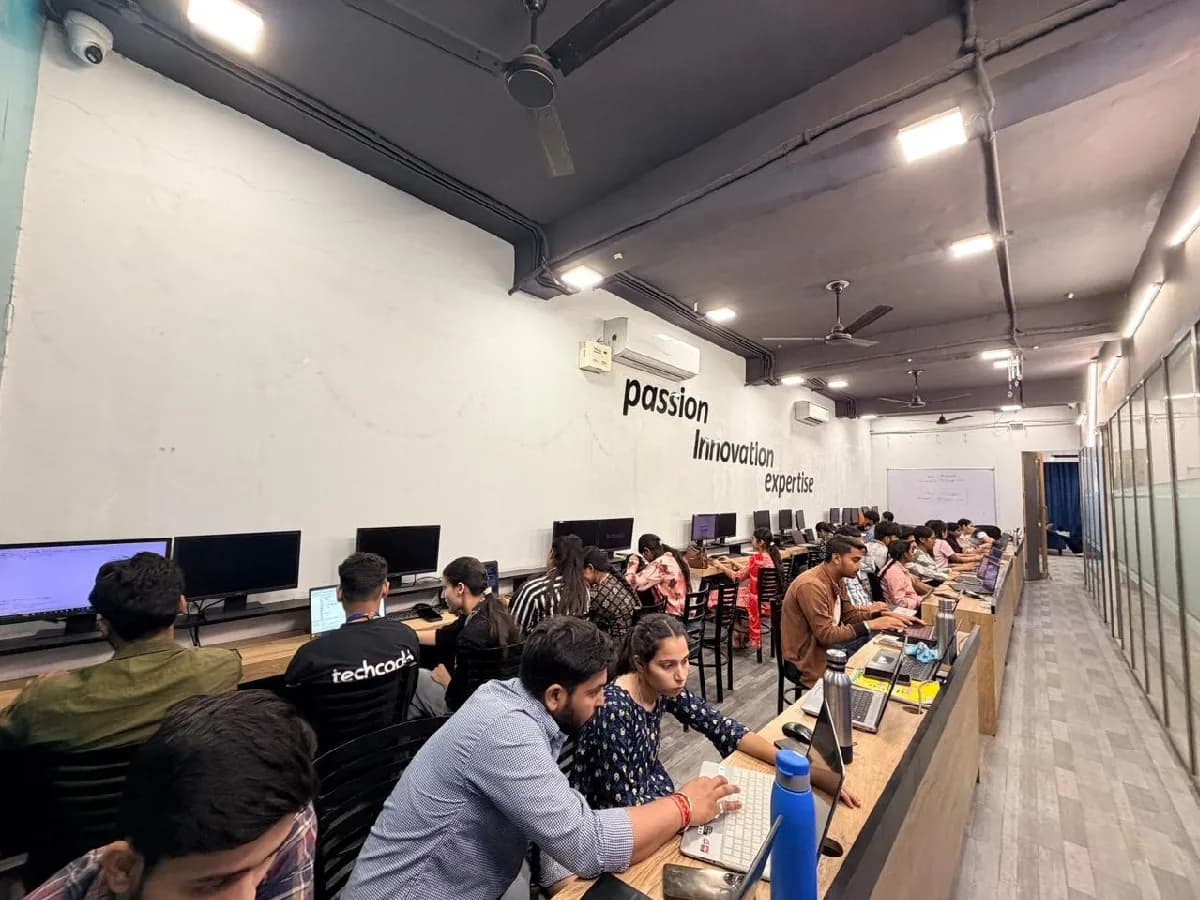
Batches stay small enough that a trainer sees your screen daily. Lab time runs outside class hours and doubt sessions continue until the concept lands.
Every student finishes with an industry-recognised certificate and a documented internship on real work, accepted for university industrial training requirements.
Mock interviews, CV reviews and drives with hiring partners across Phagwara, Jalandhar and North India, repeated after a rejection, not abandoned.
Nearly two decades of hiring relationships in Punjab is why a call from our placement cell gets answered and why local employers know what our certificate means.
What made it click for me was the lab time. You can sit after class and someone will still explain it until you get it.
I travelled in for the weekend batch and it was worth every trip. Small batch, real work, no time wasted on theory nobody uses.
The course got me interview-ready faster than I expected. My interviewer asked to see my project and that was the whole conversation.
I was switching careers and worried I would be behind. Half the batch was doing the same thing, and nobody made it awkward.
I joined with almost no background and finished with a project I could actually show. The trainer never rushed the basics.
techcadd’s placement cell kept calling me for drives until I was placed. That persistence mattered more than anything else.
It is a programme for building AI systems that pursue a goal on their own — planning a step, calling a real tool such as an API, database or browser, reading the result and going again until the job is done or a human needs to approve. Four properties make something an agent: goal-directedness, tool use, memory and autonomy. You learn to build, evaluate, secure and operate those systems on one 33-module ladder with exit points at three, six and nine months.
One call with a counsellor is usually enough to find out. Book a free demo class and see the lab before you decide.

Send your question and a counsellor will call you back about batch timings, fees, EMI options, placement record, or whether this course fits your degree.