Techcadd’s Python Programming Course in Phagwara is an industry-oriented course that teaches students, graduates, job seekers and beginners the art of coding using Python. It covers all the core concepts — Python basics, OOP, data structures, files, databases, APIs, automation and the Python libraries used in practice. The training is built on practical knowledge rather than theory: you learn through coding exercises, assignments and actual projects, so you see how Python is used in software development, automation, data handling and other technology work. The approach is beginner-friendly throughout, and the emphasis stays on problem solving, logic and coding rather than memorising syntax — by the end you are confident writing, debugging and developing Python programs of your own.
Every module ends in a working piece a trainer reviews with you — not a quiz.
Industry-ready training coursePractical topics — variables, functions, OOP, files, databases, APIs and problem solving — that turn basic coding knowledge into industry-relevant skill.
Learn by doing Python projectsPractical projects and exercises that build the ability to write clean code, debug it, manipulate data and develop useful applications.
Develop a Python project portfolioIndustry-relevant projects you can put on a CV — work that proves your coding and problem-solving ability in an interview or job hunt.
Career guidance and placement supportResume guidance, technical interview preparation, project presentation and career direction across development, automation, data science and AI/ML.
Students
25K+
Google rating
4.9★
Estd.
2007
Practical
100%
Eligibility
Who can do this course
The Python course is built for people at six different starting points, and the batch is deliberately mixed. What matters far more than your background is turning up consistently and finishing what each module asks you to build.
01
12th Pass Students
Python’s readable syntax makes it the easiest place to start. Learn variables, loops, functions, data structures, file handling and problem solving alongside your academics — a genuinely useful skill to carry into whatever you study next.
02
College Learners & Graduates
Whatever your discipline — computer science, engineering, commerce or management — Python fits. Coding exercises in automation, databases, APIs and application development also strengthen your college projects and portfolio.
03
Job Seekers & Freshers
Employers do not hire for syntax; they hire for problem solving. This builds coding logic, debugging skill and the practical portfolio that matters far more than a certificate when you apply for Python jobs in Phagwara.
04
Working Professionals
Already in IT, operations, analytics or testing? Python automates the routine parts of your current job. You do not have to switch careers — it becomes the additional skill that makes the work you already do easier.
05
Entrepreneurs & Business Owners
You do not need to become a developer to benefit. Understanding programming basics makes automation, data processing and software decisions legible — and makes briefing and judging a developer far easier.
06
Aspiring Developers & Freelancers
A solid basis for building real digital solutions: Python development, automation, APIs, databases, web technologies and project work you can bill for as a freelancer.
The case for it
Why this programme is worth your year
Python reaches further than any other first language — software development, automation, data science, AI and machine learning all run on it, and even non-programmers can learn to code with it. That gap is the whole argument for this course: there is local demand, there are budgets, and there are very few trained people to hand the work to.
The case for it
Build skills that hold up beyond the classroom.
What separates this from a playlist of tutorials is supervision on real work. From the second half of the course you build on live client projects with a trainer beside you, make decisions that have consequences, and correct them the following week. That loop is the skill. No employer in Phagwara will take your word for it without work they can inspect.
Be realistic about the money. A fresher who finishes with a working portfolio starts near the bottom of the band and moves quickly; someone who finishes with a certificate and nothing to show does not. The difference is entirely what you built.
The alternative is what most people try first: free videos, a cheap online course, six months of drifting, and knowledge you cannot demonstrate. A structured programme with live projects, a mentor who corrects you, an internship letter and a placement cell that actually calls employers is the difference between knowing the subject and being hired to do it.
Students reach the Phagwara centre from Banga, Nakodar, Kartarpur and the university belt, and the weekend batch exists so a job or a degree does not have to be paused to attend.
01
Python skills are genuinely in demand
Python reaches well beyond computer science. Startups, software companies, AI, data analytics, automation and web development all use it — which makes one skillset qualify you for several different career paths.
02
Understanding how Python really works
Not memorising commands. Logical thinking and program construction — syntax, control flow, data structures, OOP, exceptions, modules, APIs, debugging and databases — so you move from copying examples to thinking like a developer.
03
Practical training is how programming is learned
Watching tutorials is useful. Writing and debugging your own code teaches far more. Hands-on assignments and project-based training are where application development, automation and data handling actually stick.
04
Skills that open several career paths
Depending on where your interest goes, Python leads into development, web development, automation testing, data analytics, machine learning, AI or software engineering — from one foundation.
Why now
Gain Python Skills You Can Apply In Real Life
Practical projects take your skills past theory into a portfolio that proves you can code.
A strong portfolio shows you can handle fundamentals, automation, data, APIs and problem solving — in interviews and on freelance briefs alike.
Python Developer roles in Punjab start around ₹18,000 – ₹30,000 a month for a fresher with a working portfolio.
Concentrate on building projects and solving problems rather than memorising syntax — that is what separates candidates.
The syllabus is arranged so every module produces an asset rather than a set of notes. You will cover python programming fundamentals, logic, functions & problem-solving, object-oriented python programming, libraries, apis & automation, and finish with a live project built on Python, Jupyter Notebook, Google Colab. Modules run in the order a real project runs: foundations first, then the core skills, then applied work under supervision, then the portfolio and interview preparation that turn all of it into an offer letter.
Python02/04
Core Skills
The working knowledge the job description actually lists.
Object-Oriented Python Programming
Find out how professional Python applications are structured, and build the skills a Python developer role assumes.
3 weeks · 12 sessions
Libraries, APIs & Automation
Find out what Python can do beyond its basics — the libraries, the file system, and talking to services that are not yours.
3 weeks · 12 sessions
Python for Data Handling
Find out how Python is used on real-world data, from a messy export through to something a business can read.
3 weeks · 12 sessions
Topics covered
Classes, objects, methods and constructorsInheritance, encapsulation and polymorphismStructuring code into reusable componentsBuilding structured Python applicationsPopular Python libraries and modulesFiles, folders and data managementWhat an API is and how Python consumes oneAutomating repetitive tasks with PythonReading, cleaning and processing datasetsCSV, JSON and other data formatsPython tools used for data analysisThe basics of data visualisation
Programme length
Choose the duration that suits you
The Python course runs as three nested levels. Each one builds on the last, so you can start at the foundation and continue later without repeating anything.
3 MonthsFoundation
Learn the basics of Python programming
Gain fundamental Python skills step by step through practical coding and easy-to-start projects, until writing a program stops feeling difficult.
Skills & tools
Python
VS Code
Jupyter Notebook
Basic Git
Google Colab
AI coding
Recommended for
Python Trainee, Programming Intern, Junior Python Developer, and anyone starting a Python course in Phagwara.
6 MonthsProfessional
Get proficient in Python development
Go further into real-world development. Work with databases, APIs, automation and application development alongside advanced coding and problem solving.
Skills & tools
Python
MySQL
Git & GitHub
Flask / Django
REST APIs
Selenium
Recommended for
Python Developer, Junior Software Developer, Python Web Developer, Automation Developer.
9 MonthsAdvanced
Master Python development
Combine Python development with web development, databases, automation, APIs, data handling and AI — the full path from foundation to specialisation.
Skills & tools
Django
Flask
REST API
NumPy
Pandas
Google Colab
AI tools
Recommended for
Python Developer, Full-Stack Python Developer, Automation Developer, Backend Developer, Data Analyst, and the entry-level AI/ML pathway.
What changes with each duration
Capability
3 Months
6 Months
9 Months
Python fundamentals
Variables & data types
Loops & functions
Python data structures
OOP basics
File handling
Advanced Python
MySQL & database connectivity
APIs
Web development
Flask / Django
Automation & web scraping
Git & GitHub
NumPy & Pandas
Data analysis with Python
AI & Python integration
Advanced projects
Python fundamentals
3 Months
6 Months
9 Months
Variables & data types
3 Months
6 Months
9 Months
Loops & functions
3 Months
6 Months
9 Months
Python data structures
3 Months
6 Months
9 Months
OOP basics
3 Months
6 Months
9 Months
File handling
3 Months
6 Months
9 Months
Advanced Python
3 Months
6 Months
9 Months
MySQL & database connectivity
3 Months
6 Months
9 Months
APIs
3 Months
6 Months
9 Months
Web development
3 Months
6 Months
9 Months
Flask / Django
3 Months
6 Months
9 Months
Automation & web scraping
3 Months
6 Months
9 Months
Git & GitHub
3 Months
6 Months
9 Months
NumPy & Pandas
3 Months
6 Months
9 Months
Data analysis with Python
3 Months
6 Months
9 Months
AI & Python integration
3 Months
6 Months
9 Months
Advanced projects
3 Months
6 Months
9 Months
The programme is nested, not parallel. The 3-month course builds your programming foundation. The 6-month track includes those fundamentals and moves into databases, APIs, automation and application development. The 9-month programme builds further with advanced development, data analysis and AI-focused Python skills. Choose 3 months for fundamentals and problem-solving; 6 months to build applications with databases, APIs and web frameworks; 9 months to add data science and AI.
The toolchain behind the craft
One course. A mesh of real tools.
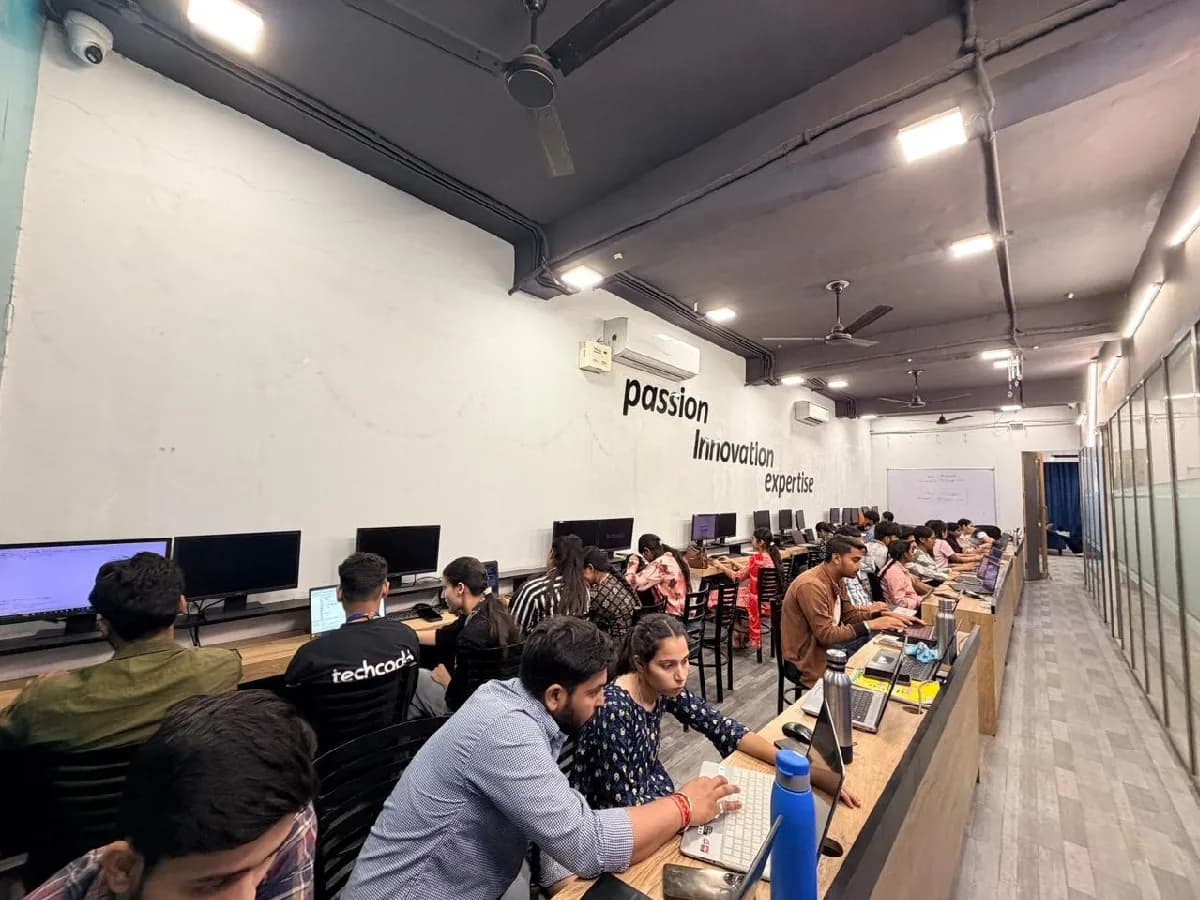
Everything below is installed on the lab machines and used on live client work, not shown once in a slide and forgotten.
Complete the course with a portfolio of live projects and receive an industry-recognised certificate, plus a documented internship letter accepted by Punjab universities.
Two certificates on completion — the course certificate and a separate capstone project certificate.
Future scope
Where this course takes you
The roles this opens, what they pay in Punjab and beyond, and who is hiring for them — drawn from published job-market listings on one comparable scale, not a brochure number.
Salary outlook
Python Developer
Builds applications, backend systems and automation in Python. Earnings depend on your coding skill, portfolio, experience, company and location.
Starting package
₹18,000–₹30,000/month
After 2 years
₹30,000–₹50,000/month
Punjab — Python Developer
Fresher₹18,000–₹30,000/month
After 2 years₹30,000–₹50,000/month
Delhi / NCR — Python & Software Development
Fresher₹25,000–₹40,000/month
After 2 years₹40,000–₹70,000+/month
Remote / Freelance Python
Fresher₹10,000–₹25,000/month
After 2 years₹30,000–₹80,000+/month
Indicative ranges for Python Developer roles, compiled from public job-market listings and drawn on the same scale in every market. Actual offers vary by employer, skillset and interview performance — Punjab pay typically reaches 2× the fresher ceiling within two years of delivery experience.
Software development companies building websites, applications and business solutions
IT startups and tech companies using Python for backend development and automation
Data and analytics companies working with Python for data processing and analysis
AI and machine learning companies developing intelligent applications and models
01
What job roles open up after Python?
Python Developer, Backend Developer, Software Developer, Automation Developer, Data Analyst and AI/ML Developer. Python reaches further than any other first language — software development, automation, data science, AI and machine learning all run on it.
02
What can I earn, and how fast does it grow?
A fresher with a working portfolio starts around ₹18,000 – ₹30,000 a month in the Punjab market, rising to ₹30,000 – ₹50,000 with two years of delivery experience. Delhi/NCR runs higher, and specialists who keep learning move well beyond it.
03
Can I freelance or work remotely with this skill?
Yes. A Phagwara address costs you nothing on a remote brief. Freelance income ramps rather than starting at a salary — around ₹10,000 – ₹25,000 a month early on, and ₹30,000 – ₹80,000+ once you have delivered real client work.
04
Which industries hire for this in Punjab?
Software development companies, IT startups using Python for backend and automation, data and analytics firms, and AI/ML companies — plus freelance and remote projects where Python developers are needed for all sorts of business purposes.
05
Can I continue to higher studies or a specialisation later?
The certificate and portfolio stand on their own, and they stack. Python is the foundation for Data Science, Machine Learning and AI tracks, so the second course is faster than the first.
Portfolio
Hands-on projects you will ship
Project 01
Python Programming & Logical Thinking Project
Write a Python program that develops logical thinking across variables, data types, operators, conditions, loops and functions. You write the code yourself and know exactly how it works.
Python
Python Basics
Project 02
Python Application Development
Build a working application from functions, modules, user input, file handling and error handling — and see how separate components fit together to solve one problem.
Python
Modules
Project 03
Python Data Handling Project
Work with real datasets: organise, clean, filter and analyse data in Python. Data handling learned practically rather than from a textbook.
Data Handling
Python Data Analysis
Project 04
Python Automation Project
Build an automation project that removes repetitive manual work — Python handling files, processing information and streamlining an everyday workflow.
File Automation
Productivity
Project 05
Python API Integration Project
Learn how a Python application talks to other services. Build something that fetches, processes and displays real-time information over an API.
REST API
JSON
Project 06
Problem Solving with Python
Take real problem statements and turn them into working Python. Develop your problem-solving approach, sharpen code logic, handle errors and write cleaner code.
Python
Debugging
Project 07
AI & Python Project
See how Python connects to Artificial Intelligence through a practical project covering libraries, data processing and the workflows that lead into Machine Learning.
Python for AI
Python Libraries
Project 08
End-to-End Python Capstone
Bring every skill together into one complete project: plan the solution, write the code, test it, fix what breaks, and present the finished work as your portfolio piece.
Python
Application Development
The working loop
Learn it. Build it. Make it yours.
Every project moves through the same loop: understand the brief, build with guidance, then explain the decisions behind your work.
01
Understand
Break a real requirement into a clear plan and the right tools.
Python Programming & Logical Thinking Project
02
Build
Work hands-on with trainer feedback while the decisions are still easy to change.
Python Application Development
03
Present
Turn the finished work into a portfolio story you can defend in an interview.
Python Data Handling Project
Why techcadd
Why students choose techcadd
There are many places to learn this in Phagwara and the brochure syllabus looks similar at all of them. What differs is who teaches, whether you ever touch real work, and whether anyone picks up the phone after you have paid. techcadd has trained students across Punjab since 2007 on the same model: small batches, working practitioners as trainers, client projects as coursework.
Trainers who explain Python simply
Python is a good place to begin, and it should feel that way. Trainers here explain programming and coding logic through simple, practical examples rather than jargon.
Live and practical Python projects
Projects make theory mean something. You learn through hands-on work spanning applications, automation, file handling, APIs, database connectivity and problem solving.
Small batches so doubts get cleared
Coding is easier when you can ask in real time. A focused environment means doubts on coding logic get solved while you are still practising the concept.
A practical portfolio you build yourself
You finish with a project portfolio demonstrating logic, automation, applications, databases and APIs — real examples a fresher can actually talk about in an interview.
Career and placement guidance
Because Python spans software development, automation, data science, AI and backend work, guidance is career-oriented: resume building, mock interviews and project presentation.
Learning Python the practical way
The aim is not to learn codes but to solve problems with Python logic — programming, OOP, data structures, automation, databases, APIs and application development.
Student reviews
What our students in Phagwara say
GGoogle
What made it click for me was the lab time. You can sit after class and someone will still explain it until you get it.
KMKaran MehtaB.Tech Student · Phagwara
GGoogle
I travelled in for the weekend batch and it was worth every trip. Small batch, real work, no time wasted on theory nobody uses.
ASArshdeep SinghTrainee Engineer · Adampur
GGoogle
The course got me interview-ready faster than I expected. My interviewer asked to see my project and that was the whole conversation.
PRPooja RaniGraduate · Kartarpur
GGoogle
What made it click for me was the lab time. You can sit after class and someone will still explain it until you get it.
KMKaran MehtaB.Tech Student · Phagwara
GGoogle
I travelled in for the weekend batch and it was worth every trip. Small batch, real work, no time wasted on theory nobody uses.
ASArshdeep SinghTrainee Engineer · Adampur
GGoogle
The course got me interview-ready faster than I expected. My interviewer asked to see my project and that was the whole conversation.
PRPooja RaniGraduate · Kartarpur
GGoogle
What made it click for me was the lab time. You can sit after class and someone will still explain it until you get it.
KMKaran MehtaB.Tech Student · Phagwara
GGoogle
I travelled in for the weekend batch and it was worth every trip. Small batch, real work, no time wasted on theory nobody uses.
ASArshdeep SinghTrainee Engineer · Adampur
GGoogle
The course got me interview-ready faster than I expected. My interviewer asked to see my project and that was the whole conversation.
PRPooja RaniGraduate · Kartarpur
GGoogle
What made it click for me was the lab time. You can sit after class and someone will still explain it until you get it.
KMKaran MehtaB.Tech Student · Phagwara
GGoogle
I travelled in for the weekend batch and it was worth every trip. Small batch, real work, no time wasted on theory nobody uses.
ASArshdeep SinghTrainee Engineer · Adampur
GGoogle
The course got me interview-ready faster than I expected. My interviewer asked to see my project and that was the whole conversation.
PRPooja RaniGraduate · Kartarpur
GGoogle
I was switching careers and worried I would be behind. Half the batch was doing the same thing, and nobody made it awkward.
SKSimran KaurCareer Switcher · Phagwara
GGoogle
I joined with almost no background and finished with a project I could actually show. The trainer never rushed the basics.
RSRohit SharmaBCA Student · Banga
GGoogle
techcadd’s placement cell kept calling me for drives until I was placed. That persistence mattered more than anything else.
NKNavjot KaurPlaced · Jalandhar
GGoogle
I was switching careers and worried I would be behind. Half the batch was doing the same thing, and nobody made it awkward.
SKSimran KaurCareer Switcher · Phagwara
GGoogle
I joined with almost no background and finished with a project I could actually show. The trainer never rushed the basics.
RSRohit SharmaBCA Student · Banga
GGoogle
techcadd’s placement cell kept calling me for drives until I was placed. That persistence mattered more than anything else.
NKNavjot KaurPlaced · Jalandhar
GGoogle
I was switching careers and worried I would be behind. Half the batch was doing the same thing, and nobody made it awkward.
SKSimran KaurCareer Switcher · Phagwara
GGoogle
I joined with almost no background and finished with a project I could actually show. The trainer never rushed the basics.
RSRohit SharmaBCA Student · Banga
GGoogle
techcadd’s placement cell kept calling me for drives until I was placed. That persistence mattered more than anything else.
NKNavjot KaurPlaced · Jalandhar
GGoogle
I was switching careers and worried I would be behind. Half the batch was doing the same thing, and nobody made it awkward.
SKSimran KaurCareer Switcher · Phagwara
GGoogle
I joined with almost no background and finished with a project I could actually show. The trainer never rushed the basics.
RSRohit SharmaBCA Student · Banga
GGoogle
techcadd’s placement cell kept calling me for drives until I was placed. That persistence mattered more than anything else.
NKNavjot KaurPlaced · Jalandhar
Side by side
How techcadd compares
Choosing a Python course should be about more than a certificate. If the goal is a career, the things worth comparing are the coding practice, the projects, the trainer support and the skills you can actually apply.
Feature
techcadd
What institutes commonly offer
Python curriculum
Industry-focused training covering Python fundamentals, OOPs, functions, modules, file handling, libraries and advanced concepts
Often focuses mainly on basic Python syntax
Learning style
Practical, coding-focused learning built around real programming problems
Can be more theory-oriented
Practical projects
Students work on coding assignments and project-based tasks to strengthen problem-solving skills
Practical exposure may be limited
Programming skills
Focus on logic building, debugging, data handling and writing efficient Python code
May cover concepts without enough coding practice
Advanced Python
Exposure to Python libraries, APIs, automation and application-based programming
Advanced topics can vary by institute
Problem solving
Regular coding exercises designed to improve logical thinking and programming confidence
Problem-solving practice may receive less attention
Portfolio building
Projects and assignments that help students showcase their Python programming skills
Portfolio development may not be a major focus
Career support
CV guidance, interview preparation, portfolio support and career-oriented guidance
Career assistance varies between institutes
Doubt support
Trainer guidance to help students understand coding concepts and solve programming challenges
Support may be limited to classroom sessions
Certification
Course completion certification supported by practical learning and project exposure
Certification and practical exposure can vary
Python curriculum
techcadd
Industry-focused training covering Python fundamentals, OOPs, functions, modules, file handling, libraries and advanced concepts
Commonly offered
Often focuses mainly on basic Python syntax
Learning style
techcadd
Practical, coding-focused learning built around real programming problems
Commonly offered
Can be more theory-oriented
Practical projects
techcadd
Students work on coding assignments and project-based tasks to strengthen problem-solving skills
Commonly offered
Practical exposure may be limited
Programming skills
techcadd
Focus on logic building, debugging, data handling and writing efficient Python code
Commonly offered
May cover concepts without enough coding practice
Advanced Python
techcadd
Exposure to Python libraries, APIs, automation and application-based programming
Commonly offered
Advanced topics can vary by institute
Problem solving
techcadd
Regular coding exercises designed to improve logical thinking and programming confidence
Commonly offered
Problem-solving practice may receive less attention
Portfolio building
techcadd
Projects and assignments that help students showcase their Python programming skills
Commonly offered
Portfolio development may not be a major focus
Career support
techcadd
CV guidance, interview preparation, portfolio support and career-oriented guidance
Commonly offered
Career assistance varies between institutes
Doubt support
techcadd
Trainer guidance to help students understand coding concepts and solve programming challenges
Commonly offered
Support may be limited to classroom sessions
Certification
techcadd
Course completion certification supported by practical learning and project exposure
Commonly offered
Certification and practical exposure can vary
The right-hand column represents common market patterns, not a comparison with any specific institute. Before choosing a Python programming institute in Phagwara, ask how much coding practice is included, whether students build real projects, how trainers handle doubts, and what career support is provided.
Got questions?
Frequently Asked Questions
It is designed to help beginners and aspiring developers learn Python through practical, career-focused training. Students learn Python fundamentals, variables, functions, OOPs, data structures, file handling, modules and real-world programming concepts with hands-on practice.
Get started today
Not sure if Python is the right fit?
One call with a counsellor is usually enough to find out. Book a free demo class and see the lab before you decide.
Send your question and a counsellor will call you back about batch timings, fees, EMI options, placement record, or whether this course fits your degree.
Free counselling and demo class
Weekday, evening, weekend or 1-on-1, all 2-hour classes