

Command Line & Logical Thinking
Work a Linux environment properly — file permissions, directory structures, process management and shell expansion, executing the commands yourself and understanding each result.
- Linux
- Command Line
Run real servers — the command line, shell scripting, users and permissions, networking, security and automation, with live projects and placement assistance.
25,000+
Students trained
since 2007
4.9★
Google rating
556+ reviews
100%
Practical training
live client work
Techcadd’s Linux Administration Course in Phagwara is an industry-oriented course that teaches students, graduates, job seekers and beginners to manage servers and systems with Linux. It covers the operating system itself, shell scripting, user administration, file systems, networking, server security and automation. The training is based on practical knowledge rather than theory: you work through command-line exercises, assignments and real server setup projects, so you see how Linux is used across IT infrastructure, cloud computing, DevOps and server management. The approach is beginner-friendly throughout, developing problem solving, command-line logic and administration ability together — by the end you can configure, secure and manage a Linux server with confidence.

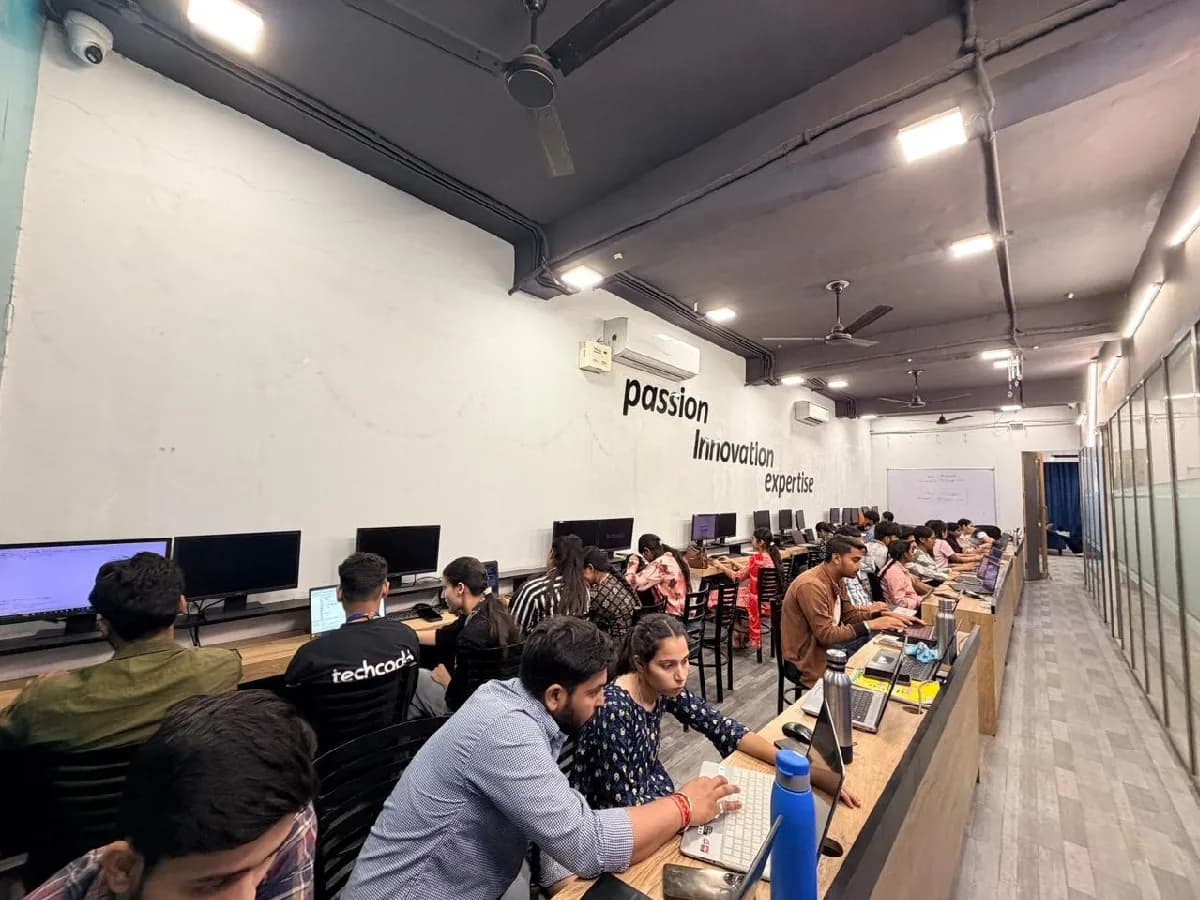
The Linux course is built for people at six different starting points, and the batch is deliberately mixed. What matters far more than your background is turning up consistently and finishing what each module asks you to build.
Interested in technology, professionally or as a hobby? Linux is a strong place to start — open source and free to practise on. You will meet directories, file permissions, user groups, process management and shell scripting alongside your academics.
System administration should be taught through practical projects, not textbooks. Whatever your discipline — computer science, engineering, commerce or management — command-line exercises in automation, networking and security strengthen your projects and portfolio.
Basic command knowledge does not move an employer. They want problem-solving and real server management. Command-line logic, debugging and a portfolio of configured servers beat a certificate every time.
Already in IT, operations or testing? Linux lets you automate routine server work and move toward DevOps. Shell scripting, user management, networking and service configuration become an additional skill, not a career change.
You do not need to be a developer to benefit. Understanding web hosting, automation and data security makes conversations with developers productive — and infrastructure decisions less opaque.
For DevOps or cloud, Linux is not optional — modern infrastructure runs on it. Server management, automation, networking and cloud basics here are what those roles are actually built on.
Linux is the floor under cloud, DevOps and security work — which makes it the cheapest course here to start on and the one that most reliably leads somewhere better paid. That gap is the whole argument for this course: there is local demand, there are budgets, and there are very few trained people to hand the work to.

Build skills that hold up beyond the classroom.
What separates this from a playlist of tutorials is supervision on real work. From the second half of the course you build on live client projects with a trainer beside you, make decisions that have consequences, and correct them the following week. That loop is the skill. No employer in Phagwara will take your word for it without work they can inspect.
Be realistic about the money. A fresher who finishes with a working portfolio starts near the bottom of the band and moves quickly; someone who finishes with a certificate and nothing to show does not. The difference is entirely what you built.
The alternative is what most people try first: free videos, a cheap online course, six months of drifting, and knowledge you cannot demonstrate. A structured programme with live projects, a mentor who corrects you, an internship letter and a placement cell that actually calls employers is the difference between knowing the subject and being hired to do it.
Students reach the Phagwara centre from Banga, Nakodar, Kartarpur and the university belt, and the weekend batch exists so a job or a degree does not have to be paused to attend.
Linux has spread well past server rooms. Startups, software companies, cloud, DevOps, cybersecurity and IT support all run on it. Administration, shell scripting, security and automation make one qualification useful across many roles.
Not memorising commands. The file system hierarchy, user and group management, permissions and ownership, process management and job control, Bash scripting, package management, networking, and service management with systemd.
Watching tutorials is useful; executing commands and debugging your own system teaches far more. Assignments cover server configuration, user security, automation and troubleshooting.
Depending on your interest, Linux leads to system administration, DevOps engineering, cloud support, cybersecurity or IT infrastructure management.
The syllabus is arranged so every module produces an asset rather than a set of notes. You will cover linux fundamentals & command line, scripting, logic & problem-solving, advanced linux administration, networking, security & firewalls, and finish with a live project built on Red Hat / CentOS / Rocky, Ubuntu / Debian, Bash Shell Scripting. Modules run in the order a real project runs: foundations first, then the core skills, then applied work under supervision, then the portfolio and interview preparation that turn all of it into an offer letter.
The working knowledge the job description actually lists.
Advanced Linux Administration
Find out how professional Linux environments are structured and kept running.
3 weeks · 12 sessions
Networking, Security & Firewalls
Find out how Linux is defended — the part that separates a server from a liability.
4 weeks · 14 sessions
Linux for DevOps & Automation
Find out how Linux underpins modern infrastructure and the tooling built on top of it.
3 weeks · 12 sessions
Topics covered
The Linux course runs as three nested levels. Each one builds on the last, so you can start at the foundation and continue later without repeating anything.
Fundamental skills step by step through practical command-line exercises and beginner-friendly projects.
Skills & tools
Recommended for
Linux Trainee, IT Support Intern, Junior System Administrator and anyone starting a Linux course in Phagwara.
Real-world work across web servers, security hardening, automation and networking, with advanced scripting and problem solving.
Skills & tools
Recommended for
Linux Administrator, System Engineer, DevOps Engineer and IT Infrastructure Specialist.
Linux combined with cloud computing, automation, security, networking and AI-assisted operations.
Skills & tools
Recommended for
Linux Administrator, DevOps Engineer, Cloud Support Engineer, Cybersecurity Analyst and IT Infrastructure Manager.
Linux fundamentals
File system navigation
User & group management
Shell scripting basics
Process management
File permissions
Advanced Bash scripting
MySQL & database integration
Network services & DNS
Web server setup (Nginx)
Ansible automation
Docker containerisation
Git & GitHub for IaC
Cloud instance management
Security hardening & SELinux
AI & Linux integration
Advanced projects
The programme is nested, not parallel. The 3-month course builds your administration foundation. The 6-month track includes those fundamentals and moves into web servers, automation and security. The 9-month programme builds further with cloud, DevOps and AI-assisted Linux work. Choose 3 months for command-line fundamentals and scripting; 6 months to manage servers, configure web services, automate with Ansible and secure environments; 9 months to add cloud computing and DevOps.
The toolchain behind the craft
Everything below is installed on the lab machines and used on live client work, not shown once in a slide and forgotten.
Complete the course with a portfolio of live projects and receive an industry-recognised certificate, plus a documented internship letter accepted by Punjab universities.
Recognised by employers across Punjab and beyond
Based on real client work, not a simulation
Live work you can show in any interview
CV review, mock interviews and hiring drives
Two certificates on completion — the course certificate and a separate capstone project certificate.
The roles this opens, what they pay in Punjab and beyond, and who is hiring for them — drawn from published job-market listings on one comparable scale, not a brochure number.
Salary outlook
Keeps the servers an organisation runs on configured, secure and up. Earnings depend on your server management skills, portfolio, experience, company and location.
Punjab — Linux Administrator
Delhi / NCR — Linux / DevOps
Remote / Freelance Linux Administration
Indicative ranges for Linux Administrator roles, compiled from public job-market listings and drawn on the same scale in every market. Actual offers vary by employer, skillset and interview performance — Punjab pay typically reaches 2× the fresher ceiling within two years of delivery experience.
Talk about your target roleLinux Administrator, System Engineer, Cloud Support Engineer and DevOps Engineer. A portfolio of configured, secured servers matters far more here than certificates.
A fresher starts around ₹18,000 – ₹28,000 a month in the Punjab market, rising to ₹28,000 – ₹45,000 with two years. That is deliberately modest against the cloud and security courses — Linux is where those careers start, not where they end, and administrators who add cloud or DevOps move into their bands quickly.
Yes — server management is remote by nature. Income ramps rather than starting at a salary: around ₹10,000 – ₹20,000 a month early on, and ₹30,000 – ₹60,000+ once you have clients whose servers you keep running. Maintenance retainers are steadier than project work here.
Software and IT service companies, startups running deployments on Linux, data centres and hosting companies, and cloud and cybersecurity firms — plus freelance server setup and maintenance.
Both, but be honest about it: Linux alone gets you into IT support and junior administration, which is a real job with a modest ceiling. Its bigger value is as the prerequisite for cloud, DevOps and security — every one of those pays better and every one assumes you already have this. Take it first if you are starting out; take it alongside cloud if you already have IT experience.
Work a Linux environment properly — file permissions, directory structures, process management and shell expansion, executing the commands yourself and understanding each result.
Build a working web server on Linux with Apache or Nginx, firewalls and user permissions — and see how the pieces combine to host a real site.
Automate real tasks: schedule backups, clean logs and monitor system health with Bash scripts and cron rather than remembering to do it.
Secure a Linux server properly — SSH configuration, firewalls, SELinux and fail2ban, closing the gaps an exposed box actually gets probed for.
Configure DNS and DHCP, then troubleshoot connectivity when it does not work — the skill that gets called at 2am.
Take real infrastructure problems and turn them into efficient solutions, building troubleshooting instinct and cleaner scripts.
See where Linux administration meets AI — infrastructure automation, data processing and the tooling that leads toward DevOps and AI infrastructure.
Build a complete infrastructure project: plan it, implement it, test its security, fix what breaks and present the finished work.
The working loop
Every project moves through the same loop: understand the brief, build with guidance, then explain the decisions behind your work.
Turn a realistic business requirement into an infrastructure strategy — system analysis, choosing the right distribution and planning the server architecture.
System Analysis & Linux Environment Brief
Create and manage servers with trainer guidance — user accounts, firewalls, shell scripts and web servers, with AI-assisted troubleshooting where it helps.
Linux Server Setup & Security Hardening
Present your server architecture, security measures, automation scripts and the troubleshooting behind them — then take the work into your portfolio.
End-to-End Linux Infrastructure & Optimisation
There are many places to learn this in Phagwara and the brochure syllabus looks similar at all of them. What differs is who teaches, whether you ever touch real work, and whether anyone picks up the phone after you have paid. techcadd has trained students across Punjab since 2007 on the same model: small batches, working practitioners as trainers, client projects as coursework.
Linux is a good place for beginners when taught well. Trainers here explain concepts and command-line logic through simple, practical examples rather than man pages.
Projects make the theory meaningful. You learn through hands-on work spanning server setup, automation, security, networking and troubleshooting.
System administration is far easier when you can clear a doubt on command-line logic in real time and practise the configuration while you are still stuck on it.
You finish with projects demonstrating server security, automation, user management and networking — real examples a fresher can discuss in an interview.
Because Linux underpins cloud, DevOps, security and hosting, guidance is career-oriented: resume building, mock interviews and project presentation.
The aim is solving problems with Linux tooling, not learning commands — practical administration, shell scripting, user management, security, automation and networking.
What made it click for me was the lab time. You can sit after class and someone will still explain it until you get it.
I travelled in for the weekend batch and it was worth every trip. Small batch, real work, no time wasted on theory nobody uses.
The course got me interview-ready faster than I expected. My interviewer asked to see my project and that was the whole conversation.
I was switching careers and worried I would be behind. Half the batch was doing the same thing, and nobody made it awkward.
I joined with almost no background and finished with a project I could actually show. The trainer never rushed the basics.
techcadd’s placement cell kept calling me for drives until I was placed. That persistence mattered more than anything else.
Choosing a Linux course should be about more than a certificate. If the goal is a career, the things worth comparing are the coding practice, the projects, the trainer support and the skills you can actually apply.
Linux curriculum
techcadd
Industry-focused training covering fundamentals, shell scripting, user management, security and advanced concepts
Commonly offered
Often focuses mainly on basic Linux commands
Learning style
techcadd
Practical, command-line focused learning built around real IT problems
Commonly offered
Can be more theory-oriented
Practical projects
techcadd
Students work on server setups and security assignments to strengthen problem-solving skills
Commonly offered
Practical exposure may be limited
Technical skills
techcadd
Focus on logic building, scripting, troubleshooting and writing efficient commands
Commonly offered
May cover concepts without enough hands-on practice
Advanced Linux
techcadd
Exposure to shell scripting, APIs, automation and server security
Commonly offered
Advanced topics can vary by institute
Problem solving
techcadd
Regular command-line exercises designed to improve logical thinking and technical confidence
Commonly offered
Problem-solving practice may receive less attention
Portfolio building
techcadd
Projects and assignments that help students showcase their Linux skills
Commonly offered
Portfolio development may not be a major focus
Career support
techcadd
CV guidance, interview preparation, portfolio support and career-oriented guidance
Commonly offered
Career assistance varies between institutes
Doubt support
techcadd
Trainer guidance to help students understand server concepts and solve technical challenges
Commonly offered
Support may be limited to classroom sessions
Certification
techcadd
Course completion certification supported by practical learning and project exposure
Commonly offered
Certification and practical exposure can vary
The right-hand column represents common market patterns, not a comparison with any specific institute. Before choosing a Linux institute in Phagwara, ask how much command-line practice is included, whether students build real server projects, how trainers handle doubts, and what career support is provided.
It is designed to help beginners and aspiring system administrators learn Linux through practical, career-focused training. Students learn fundamentals, shell scripting, user management, security, networking and real server concepts with hands-on practice.
One call with a counsellor is usually enough to find out. Book a free demo class and see the lab before you decide.

Send your question and a counsellor will call you back about batch timings, fees, EMI options, placement record, or whether this course fits your degree.