

Library management system
Classes, inheritance and file storage behind a working console application.
- C++
Object-oriented programming, STL and data structures — the standard prerequisite for competitive programming and interviews.
25,000+
Students trained
since 2007
4.9★
Google rating
556+ reviews
100%
Practical training
live client work
Get started in programming with structured C++ training in Phagwara. You learn the C++ language alongside data structures and object-oriented programming, which makes it a strong first language for understanding programming concepts and problem-solving approaches. Built for beginners: the track starts at fundamentals and progresses to templates, the STL and algorithmic thinking.
The C++ course is built for people at six different starting points, and the batch is deliberately mixed. What matters far more than your background is turning up consistently and finishing what each module asks you to build.
Join from any stream. You start from fundamentals with no assumed knowledge, and most students run the course alongside a degree at a Phagwara college using the weekday or weekend batch.
If you are finishing a BA, BBA, B.Com, BCA or B.Tech, this is the shortest route from degree to salary. Enter placement season with project work in hand instead of a blank CV.
The weekend batch exists for people already earning. Career switchers typically become interview-ready within five to six months without leaving their current job.
Skills you can bill for, plus the delivery habits clients expect — scoping, revisions and handover done the way an agency does them.
Enough hands-on depth to build the work yourself, or to brief and judge it properly when you hire someone else to.
A structured route in from another field, with honest guidance on how to position the move and what the first year actually pays.
C++ and its data structures work is what technical interviews are actually built on, and it opens game, graphics and systems roles almost nothing else reaches. That gap is the whole argument for this course: there is local demand, there are budgets, and there are very few trained people to hand the work to.
Build skills that hold up beyond the classroom.
What separates this from a playlist of tutorials is supervision on real work. From the second half of the course you build on live client projects with a trainer beside you, make decisions that have consequences, and correct them the following week. That loop is the skill. No employer in Phagwara will take your word for it without work they can inspect.
Be realistic about the money. A fresher who finishes with a working portfolio starts near the bottom of the band and moves quickly; someone who finishes with a certificate and nothing to show does not. The difference is entirely what you built.
The alternative is what most people try first: free videos, a cheap online course, six months of drifting, and knowledge you cannot demonstrate. A structured programme with live projects, a mentor who corrects you, an internship letter and a placement cell that actually calls employers is the difference between knowing the subject and being hired to do it.
Students reach the Phagwara centre from Banga, Nakodar, Kartarpur and the university belt, and the weekend batch exists so a job or a degree does not have to be paused to attend.
Built backwards from live job descriptions and rewritten as the stack moves.
You spend more time building than watching. Every concept lands in working code.
Small batches, direct access to your trainer, and reviews on the work you produce.
The same editors, version control and deployment tooling teams use in production.
Mock rounds, portfolio review and the questions this particular role gets asked.
The programme ends with work you can show and a plan for the roles you are targeting.
The syllabus is arranged so every module produces an asset rather than a set of notes. You will cover basics of c++, conditions & loops, c++ data structures, functions & modular programming, and finish with a live project built on C++, Visual Studio Code, Visual Studio. Modules run in the order a real project runs: foundations first, then the core skills, then applied work under supervision, then the portfolio and interview preparation that turn all of it into an offer letter.
The working knowledge the job description actually lists.
Functions & modular programming
Reusable functions, parameters and return values, function overloading, recursion and modular programs.
2 weeks · 10 sessions
Object-oriented programming
Classes and objects, constructors and destructors, inheritance, polymorphism, encapsulation and abstraction.
3 weeks · 14 sessions
Pointers, references & memory
Pointers, references, dynamic memory allocation and memory management, and how they are used in C++.
2 weeks · 10 sessions
Topics covered
The toolchain behind the craft
Everything below is installed on the lab machines and used on live client work, not shown once in a slide and forgotten.
Complete the course with a portfolio of live projects and receive an industry-recognised certificate, plus a documented internship letter accepted by Punjab universities.
Recognised by employers across Punjab and beyond
Based on real client work, not a simulation
Live work you can show in any interview
CV review, mock interviews and hiring drives
Two certificates on completion — the course certificate and a separate capstone project certificate.
The roles this opens, what they pay in Punjab and beyond, and who is hiring for them — drawn from published job-market listings on one comparable scale, not a brochure number.
Salary outlook
Builds performance-critical software — tooling, engines and systems work.
Punjab / Tricity
Delhi NCR
Remote / Freelance
Indicative ranges for C++ Developer roles, compiled from public job-market listings and drawn on the same scale in every market. Actual offers vary by employer, skillset and interview performance — Punjab pay typically reaches 2× the fresher ceiling within two years of delivery experience.
Talk about your target roleGraduates move into C++ Developer, Software Developer, Backend Developer, Game Developer and similar roles. C++ and its data structures work is what technical interviews are actually built on, and it opens game, graphics and systems roles almost nothing else reaches.
A fresher with a working portfolio starts around ₹20,000 – ₹33,000 a month in the Phagwara market. With two years of delivery experience that typically doubles, and specialists who keep learning move well beyond it.
Yes. A Phagwara address costs you nothing on a remote brief. Students bill clients in Delhi, Dubai and Canada. The course covers client handling, proposals and reporting so you can price and defend your work, not just do it.
Beyond IT companies, the agro and food processing units, immigration consultancies, hospitals, schools, hotels and the university belt around Phagwara all now hire for these skills directly.
The certificate and portfolio stand on their own, and they stack. Most students move on to an adjacent techcadd track. The tools overlap, so the second course is faster than the first.
Classes, inheritance and file storage behind a working console application.
Vectors, maps, stacks and queues exercised against searching and sorting problems.
Game loop, collision logic and dynamic memory, built with templates and operator overloading.
The working loop
Every project moves through the same loop: understand the brief, build with guidance, then explain the decisions behind your work.
Break a real requirement into a clear plan and the right tools.
Library management system
Work hands-on with trainer feedback while the decisions are still easy to change.
STL data structures workbench
Turn the finished work into a portfolio story you can defend in an interview.
Console game engine
There are many places to learn this in Phagwara and the brochure syllabus looks similar at all of them. What differs is who teaches, whether you ever touch real work, and whether anyone picks up the phone after you have paid. techcadd has trained students across Punjab since 2007 on the same model: small batches, working practitioners as trainers, client projects as coursework.
Your trainer is not a full-time lecturer. They deliver client projects for techcadd’s services arm, so examples in class are current rather than a case study from five years ago.
You work on genuine client requirements under supervision. This is where a portfolio comes from, and it is the first thing an interviewer asks to see.
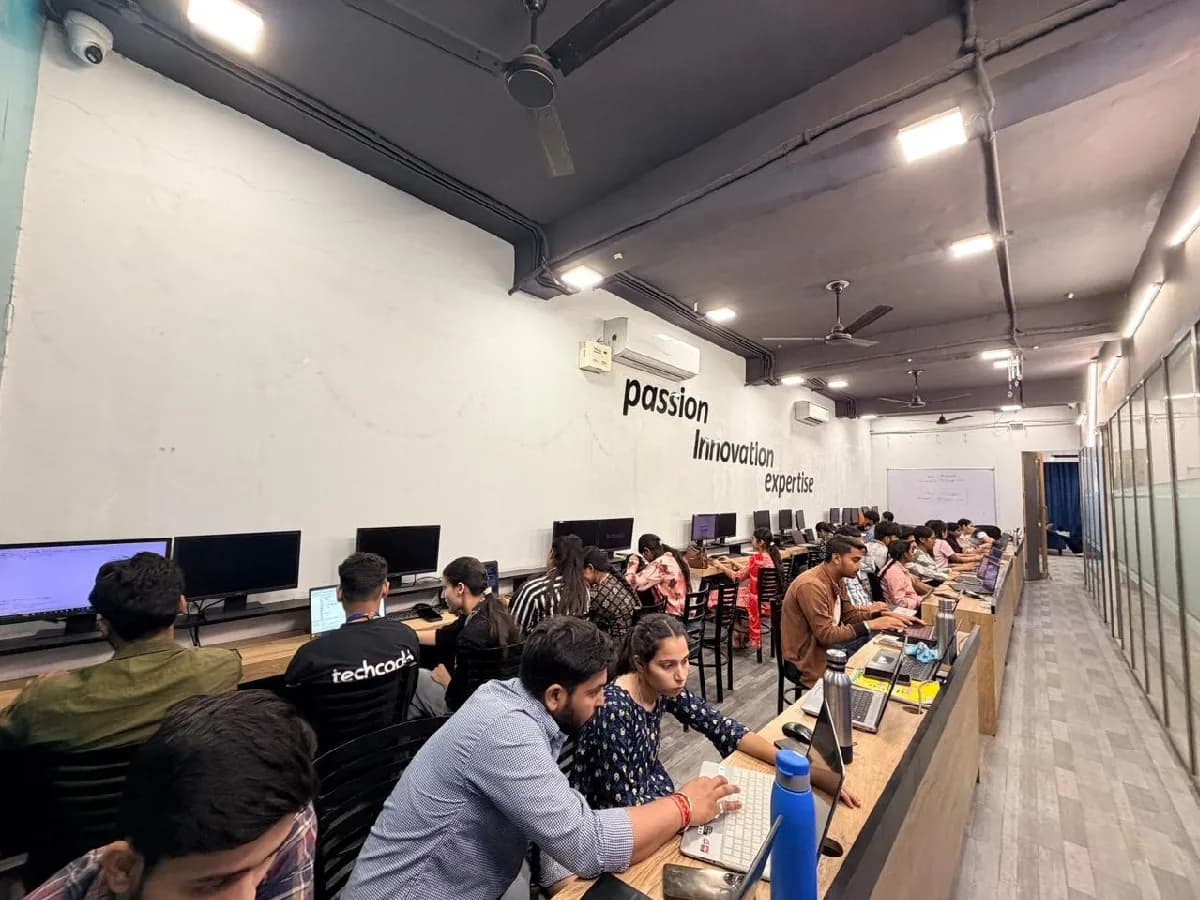
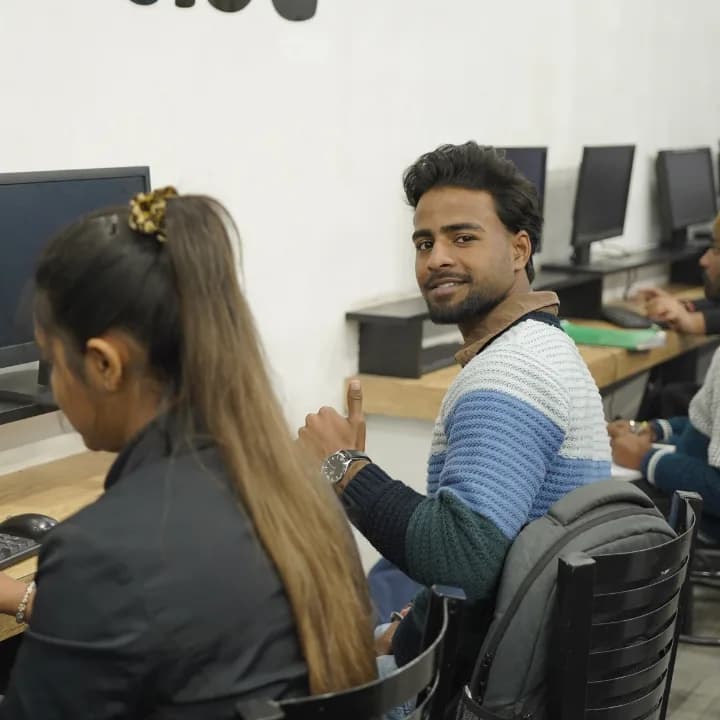
Batches stay small enough that a trainer sees your screen daily. Lab time runs outside class hours and doubt sessions continue until the concept lands.
Every student finishes with an industry-recognised certificate and a documented internship on real work, accepted for university industrial training requirements.
Mock interviews, CV reviews and drives with hiring partners across Phagwara, Jalandhar and Ludhiana, repeated after a rejection, not abandoned.
Nearly two decades of hiring relationships in Punjab is why a call from our placement cell gets answered and why local employers know what our certificate means.
What made it click for me was the lab time. You can sit after class and someone will still explain it until you get it.
I travelled in for the weekend batch and it was worth every trip. Small batch, real work, no time wasted on theory nobody uses.
The course got me interview-ready faster than I expected. My interviewer asked to see my project and that was the whole conversation.
I was switching careers and worried I would be behind. Half the batch was doing the same thing, and nobody made it awkward.
I joined with almost no background and finished with a project I could actually show. The trainer never rushed the basics.
techcadd’s placement cell kept calling me for drives until I was placed. That persistence mattered more than anything else.
techcadd runs C++ over 2 months depending on the track you choose. Weekday, evening and weekend batches cover the same syllabus, and 1-on-1 training is available if you would rather set your own pace. Every class runs for 2 hours, whichever format you choose.
One call with a counsellor is usually enough to find out. Book a free demo class and see the lab before you decide.
Send your question and a counsellor will call you back about batch timings, fees, EMI options, placement record, or whether this course fits your degree.