Dashboards and Reporting
Business dashboards and KPI reporting built in Power BI with DAX, on data shaped in Excel and Power Query — the first thing you can show anyone, built in month one.
- Power BI
- DAX
A nine-month, project-driven path from data fundamentals to enterprise-grade AI systems — Python, data engineering, machine learning, deep learning, LLMs, RAG, AI agents and full production deployment, finishing on a complete AI SaaS capstone you build and ship yourself.
This is a nine-month AI course, arranged so that each topic is usable before the next arrives. It is built as a single continuous path rather than a set of short courses stapled together — you learn to handle data before you model it, to model before you reach for a language model, and to deploy before you are asked to secure and maintain what you deployed. The final month is given entirely to one enterprise-grade AI SaaS application that you build end to end.
Key Highlights
This is a nine-month AI course, arranged so that each topic is usable before the next arrives. It is built as a single continuous path rather than a set of short courses stapled together — you learn to handle data before you model it, to model before you reach for a language model, and to deploy before you are asked to secure and maintain what you deployed. The final month is given entirely to one enterprise-grade AI SaaS application that you build end to end. Months one to three are the foundation, and they start further back than most AI courses do. Month 1 is data and programming: advanced Excel and Power Query, Power BI with DAX, then Python from fundamentals through VS Code, the uv package manager and virtual environments, and on into real engineering practice — object-oriented design, exception handling, logging, type hinting, pytest, Ruff and Black. Month 2 is the developer’s toolkit and the data layer: Git, GitHub and Git Flow alongside AI coding tools; PostgreSQL with database design, window functions and query optimisation; APIs, JSON, FastAPI basics with JWT and Postman; then Pandas 2.x, NumPy, Polars, DuckDB and PyArrow. Month 3 turns that into data science: cleaning, feature engineering, EDA and interactive visualisation, statistics and probability, scikit-learn with pipelines and cross-validation, then XGBoost, LightGBM and CatBoost. Months four to six are the modern AI core. Month 4 is deep learning and computer vision in PyTorch — tensor operations and neural networks, CNNs and transfer learning with OpenCV, YOLO object detection, OCR, image segmentation and Vision Transformers, then Transformers and Hugging Face. Month 5 opens the language-model half: tokenization, embeddings, context windows and attention; prompt engineering; the OpenAI, Gemini, Claude and Grok APIs plus Ollama and LiteLLM; then embeddings and vector databases across FAISS, ChromaDB, Pinecone, Qdrant and Milvus. Month 6 is where those pieces become systems: RAG architecture with hybrid search, re-ranking, evaluation and guardrails; LangChain and LangGraph; CrewAI, the Model Context Protocol, tool and function calling; then AI agents, multi-agent systems and enterprise agent design. Months seven to nine are what separates a demo from a product. Month 7 is application development and deployment: advanced FastAPI with async, background tasks and WebSockets; Streamlit, Gradio and Chainlit; Docker, Linux, Nginx; then AWS, Azure AI, Google Vertex AI, Hugging Face Spaces and serverless deployment. Month 8 is the operational discipline — MLflow, DVC, model registries, experiment tracking and model monitoring; GitHub Actions and CI/CD; AI security covering prompt injection, jailbreak defence, secret management and responsible AI; then fine-tuning with PEFT, LoRA, QLoRA, quantization and knowledge distillation. Month 9 adds multimodal AI and enterprise architecture with microservices, event-driven systems, Redis, Celery and Kafka, before the capstone.
Every module ends in something you have built and a trainer has reviewed, so the list below is work you will have done rather than topics you will have heard about.
Excel and SQL through Pandas, Polars, DuckDB and PyArrow
and when not to
The syllabus is arranged so every module produces an asset rather than a set of notes. You will cover month 1 — data & programming foundations, month 2 — dev tools & data engineering, month 3 — data science & machine learning, month 4 — deep learning & computer vision, and finish with a live project built on Excel, Power Query, Power BI & DAX, Python, uv, pytest, Ruff & Black, Git, GitHub, Copilot, Cursor & Windsurf. Modules run in the order a real project runs: foundations first, then the core skills, then applied work under supervision, then the portfolio and interview preparation that turn all of it into an offer letter.
The working knowledge the job description actually lists.
Month 3 — Data Science & Machine Learning
A full modelling cycle with honest evaluation.
4 weeks · 24 sessions
Month 4 — Deep Learning & Computer Vision
PyTorch from tensors up, through detection, OCR and Vision Transformers.
4 weeks · 24 sessions
Month 5 — LLM Fundamentals & Vector Search
The language-model half opens: internals, prompting, four APIs and five vector databases.
4 weeks · 24 sessions
Topics covered
The toolchain
Everything below is installed on the lab machines and used on live client work, not shown once in a slide and forgotten.
Any stream. Month 1 begins at spreadsheets and Python basics, and the sequencing means you are never asked to use a tool you have not already been taught to build with.
Short AI courses tend to start at prompt engineering and stop at a chatbot. This one covers the data layer beneath it and the deployment, monitoring and security above it — which is where most projects actually fail.
Months 5 and 6 are given entirely to language models: tokenization and attention, prompting, four model APIs plus local inference, five vector databases, RAG with re-ranking and guardrails, LangGraph, CrewAI and MCP.
Docker, Nginx, three cloud AI platforms, CI/CD with GitHub Actions, MLflow experiment tracking and model monitoring. The capstone is deployed, not demoed on a laptop.
The engineering practice in Month 1 — OOP, logging, type hinting, pytest, Ruff — is the part that makes a portfolio readable to an interviewer, and it is taught early rather than assumed.
The final month is explicitly about delivery: project documentation, code review practice, repository management and industry standards, alongside resume and portfolio guidance.
The failures in real AI projects are usually not modelling failures — they are data failures, deployment failures and monitoring failures, and this is the only track here that covers all three ends. That gap is the whole argument for this course: there is local demand, there are budgets, and there are very few trained people to hand the work to.
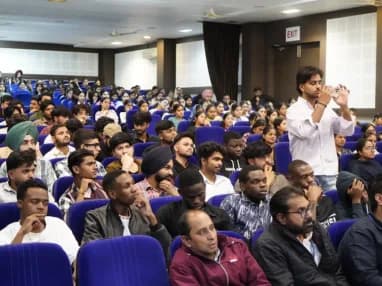
Build skills that hold up beyond the classroom.
What separates this from a playlist of tutorials is supervision on real work. From the second half of the course you build on live client projects with a trainer beside you, make decisions that have consequences, and correct them the following week. That loop is the skill. No employer in Phagwara will take your word for it without work they can inspect.
Be realistic about the money. A fresher who finishes with a working portfolio starts near the bottom of the band and moves quickly; someone who finishes with a certificate and nothing to show does not. The difference is entirely what you built.
The alternative is what most people try first: free videos, a cheap online course, six months of drifting, and knowledge you cannot demonstrate. A structured programme with live projects, a mentor who corrects you, an internship letter and a placement cell that actually calls employers is the difference between knowing the subject and being hired to do it.
Students reach the Phagwara centre from Banga, Nakodar, Kartarpur and the university belt, and the weekend batch exists so a job or a degree does not have to be paused to attend.
Data before models, models before language models, deployment before operations. Nothing is used before it has been built.
PostgreSQL with window functions and query optimisation, Pandas 2.x, NumPy, Polars, DuckDB and PyArrow — the pipelines everything downstream depends on.
FAISS, ChromaDB, Pinecone, Qdrant and Milvus; OpenAI, Gemini, Claude and Grok, plus Ollama and LiteLLM for local and routed inference.
LangGraph state machines, CrewAI crews, MCP tool calling, structured outputs, multi-agent systems and enterprise agent design — not prompt tricks.
Docker and Nginx, AWS, Azure AI and Vertex AI, GitHub Actions CI/CD, MLflow and DVC, model monitoring, prompt injection and jailbreak defence.
An AI SaaS with FastAPI, PostgreSQL, RAG and agents, containerised and deployed — documented, code-reviewed and shipped from a managed GitHub repository.
Complete the course with a portfolio of live projects and receive an industry-recognised certificate, plus a documented internship letter accepted by Punjab universities.
Recognised by employers across Punjab and beyond
Based on real client work, not a simulation
Live work you can show in any interview
CV review, mock interviews and hiring drives
Two certificates on completion — the course certificate and a separate capstone project certificate.
The roles this opens, what they pay in Punjab and beyond, and who is hiring for them — drawn from published job-market listings, not a brochure number.
Building software with models inside it — FastAPI, RAG, agents and a deployed interface. The capstone is the evidence this interview asks for.
Experiment tracking, model registries, CI/CD and monitoring. Month eight is this role’s foundation and it is one of the less contested entry points.
Training, tuning and evaluating models — scikit-learn pipelines, gradient boosting and PyTorch across months three and four.
The model layer: tokenization, embeddings, context windows, multi-provider routing and fine-tuning with LoRA and QLoRA.
The earliest employable point in the course — the Power BI, SQL and Python work of months one to three is enough on its own.
Business dashboards and KPI reporting built in Power BI with DAX, on data shaped in Excel and Power Query — the first thing you can show anyone, built in month one.
A PostgreSQL schema you designed, queried with window functions and tuned for performance, served through a FastAPI endpoint with JWT authentication and tested in Postman.
A full modelling cycle: cleaning and feature engineering, EDA with Plotly and Streamlit, scikit-learn pipelines with cross-validation, then gradient boosting with hyperparameter optimisation and honest evaluation.
PyTorch neural networks, a CNN adapted by transfer learning, and a detection pipeline using YOLO, OCR and image segmentation with OpenCV — plus Hugging Face transformers and tokenizers.
Embeddings indexed in a vector database, then a full RAG system with hybrid search, re-ranking, evaluation and guardrails — built up into multi-agent autonomous workflows with CrewAI and MCP.
The whole of month nine: an end-to-end enterprise-grade AI SaaS with FastAPI and PostgreSQL, RAG pipelines and AI agents, Docker containerisation and full cloud deployment — delivered with documentation, code review and a managed GitHub repository.
Every project moves through the same loop: understand the brief, build with guidance, then explain the decisions behind your work.
Take a real requirement apart before touching a tool — what is being asked, what it needs, and which part to build first.
Dashboards and Reporting
Work hands-on with your trainer watching the screen, so a wrong turn is caught in the same session rather than three weeks later.
A Queried Database and a Working API
Walk through what you built and why you built it that way. This is the interview rehearsal, run against every project rather than once at the end.
Trained and Tuned Models
There are many places to learn this in Phagwara and the brochure syllabus looks similar at all of them. What differs is who teaches, whether you ever touch real work, and whether anyone picks up the phone after you have paid. techcadd has trained students across Punjab since 2007 on the same model: small batches, working practitioners as trainers, client projects as coursework.
Excel, Power Query, Power BI and Python fundamentals come first. A school leaver with no coding background is the intended starting point, not an exception the course tolerates.
OOP, exception handling, logging, type hinting, pytest, Ruff and Black in Month 1 — so the code you write in month seven is code someone else can read.
uv for environments, GitHub Copilot, Cursor and Windsurf for AI-assisted coding, Postman for APIs. You use the tools the job uses, and you learn what they are doing for you.
Dashboards in month one, pipelines in month two, trained models in month three, a vision system in month four, a RAG application in month six, a deployed service in month seven.
The final month covers project documentation, code review best practice, GitHub repository management and industry standards — the part of a portfolio that gets it taken seriously.
Guided support building your resume and portfolio, on top of the Course Completion Certificate. Placement support is support, not a job guarantee.
Find answers to the questions students ask before enrolling.
Nine months of structured, hands-on training. Months 1 to 3 cover data and programming foundations, dev tools and data engineering, then data science and machine learning. Months 4 to 6 cover deep learning and computer vision, LLM fundamentals and vector search, then RAG, LangChain and AI agents. Months 7 to 9 cover application development and deployment, MLOps, security and fine-tuning, then multimodal AI and the enterprise capstone.

Send your question and a counsellor will call you back about batch timings, fees, EMI options, placement record, or whether this course fits your degree.
One call with a counsellor is usually enough to find out. Book a free demo class and see the lab before you decide.