

Async LLM Client Library
Rate-limited, retried, cached and fully typed, with 90%+ test coverage and a resumable 100,000-record enrichment run behind it.
- asyncio
- httpx
- Tenacity
- pytest
A complete six-month program that turns you from a beginner into someone who can build, secure and deploy AI agents that work reliably for real users at a manageable cost.
This 6-month program covers the complete journey from Python basics to production-ready AI agents. The first half builds your foundation — Python from the first line, the command line and Git, HTTP and APIs, how language models actually work, prompting, tool calling, RAG, memory and graph orchestration. The second half is the professional half: async engineering, model routing and self-hosted serving, DSPy optimisation, production MCP gateways, GraphRAG, durable execution, multi-agent systems, browser and coding agents, evaluation harnesses, red teaming, Kubernetes deployment and unit economics.
Key Highlights
This 6-month program covers the complete journey from Python basics to production-ready AI agents. The first half builds your foundation — Python from the first line, the command line and Git, HTTP and APIs, how language models actually work, prompting, tool calling, RAG, memory and graph orchestration. The second half is the professional half: async engineering, model routing and self-hosted serving, DSPy optimisation, production MCP gateways, GraphRAG, durable execution, multi-agent systems, browser and coding agents, evaluation harnesses, red teaming, Kubernetes deployment and unit economics. You advance when your work passes review, not when the calendar says so. Every topic specifies the same four things — subjects in teaching order, the named tool stack, the commercial problem it solves and the project you keep.
Every module ends in something you have built and a trainer has reviewed, so the list below is work you will have done rather than topics you will have heard about.
bounded concurrency, circuit breakers, dead-letter queues and resumable checkpoints
The syllabus is arranged so every module produces an asset rather than a set of notes. You will cover month 1 — python, llm prompting & tool calling, month 2 — rag, memory & agent frameworks, month 3 — evaluation, guardrails & a deployed agent, month 4 — production python, model routing & prompt optimisation, and finish with a live project built on Python & asyncio, Git, GitHub & Docker, FastAPI & PostgreSQL. Modules run in the order a real project runs: foundations first, then the core skills, then applied work under supervision, then the portfolio and interview preparation that turn all of it into an offer letter.
The working knowledge the job description actually lists.
Month 3 — Evaluation, Guardrails & a Deployed Agent
Evidence is the deliverable, and the agent goes live.
4 weeks · 24 sessions
Topics covered
The toolchain
Everything below is installed on the lab machines and used on live client work, not shown once in a slide and forgotten.
Join from any stream. Six months is the shortest honest span in which a complete beginner reaches an AI Engineer job description, and the weekday and weekend batches both run the full ladder.
If you are finishing a BCA, B.Sc or B.Tech, this is the version of the programme that changes which interviews you are invited to. You arrive with a red-team report and a Kubernetes deployment, not a course certificate.
If you already write Python, the foundation topics are quick and the professional topics are the real value. Containers, evaluation, security and cost engineering are what separate a developer from someone who can also ship and run what they wrote.
The weekend batch exists for people already earning. Six months of evenings and Saturdays is enough to move into AI engineering without leaving your current job first.
Companies have agents in production and almost nobody who can evaluate, secure and operate them — which is currently the most valuable gap an AI engineer can close. That gap is the whole argument for this course: there is local demand, there are budgets, and there are very few trained people to hand the work to.
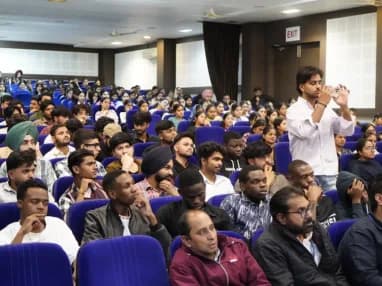
Build skills that hold up beyond the classroom.
What separates this from a playlist of tutorials is supervision on real work. From the second half of the course you build on live client projects with a trainer beside you, make decisions that have consequences, and correct them the following week. That loop is the skill. No employer in Phagwara will take your word for it without work they can inspect.
Be realistic about the money. A fresher who finishes with a working portfolio starts near the bottom of the band and moves quickly; someone who finishes with a certificate and nothing to show does not. The difference is entirely what you built.
The alternative is what most people try first: free videos, a cheap online course, six months of drifting, and knowledge you cannot demonstrate. A structured programme with live projects, a mentor who corrects you, an internship letter and a placement cell that actually calls employers is the difference between knowing the subject and being hired to do it.
Students reach the Phagwara centre from Banga, Nakodar, Kartarpur and the university belt, and the weekend batch exists so a job or a degree does not have to be paused to attend.
Async concurrency, rate limits, retries with jitter, circuit breakers, resumable checkpoints and dead-letter queues. This is the difference between a notebook demo and a batch job that survives the night.
Model routing sends trivial work to a small local model and only hard reasoning to a frontier one — the standard route to a 60–80% inference-cost reduction with no measurable quality loss.
You run a 200-attack automated red-team suite against your own agent, with a before-and-after mitigation report. Prompt injection is the defining unsolved risk of tool-using systems, and defence is architectural.
You do not assume more agents are better. You build the system, then report head-to-head against a single-agent baseline on cost, latency and success rate — which is the question a reviewer will ask.
Complete the course with a portfolio of live projects and receive an industry-recognised certificate, plus a documented internship letter accepted by Punjab universities.
Recognised by employers across Punjab and beyond
Based on real client work, not a simulation
Live work you can show in any interview
CV review, mock interviews and hiring drives
Two certificates on completion — the course certificate and a separate capstone project certificate.
The roles this opens, what they pay in Punjab and beyond, and who is hiring for them — drawn from published job-market listings, not a brochure number.
Mid level, and the most common destination from this course. Interviews test evaluation methodology, cost control and production incidents you have personally handled. Show the model router, the red-team report and the Kubernetes deployment with an SLO.
Senior-adjacent. Interviews test multi-tenancy, durable execution, gateway design and observability at scale. Show the durable procurement agent and the OAuth-protected MCP gateway.
The role that connects agents to the systems a company already runs. The production MCP section is exactly this job — scoped tools, audit logs and per-user permissions rather than a shared API key.
On-call for agents. Tracing, drift detection, shadow deployment, canary releases and the cost dashboard — the work this course grades you on in the evaluation, deployment and cost-engineering sections.
Salary outlook — AI Engineer
Builds, evaluates, secures and operates agents in production. Agent engineering is currently one of the few fields where supply is well behind demand.
Indicative ranges compiled from public job-market listings. Actual offers vary by employer, skillset and interview performance.
Rate-limited, retried, cached and fully typed, with 90%+ test coverage and a resumable 100,000-record enrichment run behind it.
A cascading router with automatic fallback and a self-hosted vLLM endpoint, benchmarked across five models on cost, quality and latency.
Hybrid search plus reranking plus a knowledge graph, with an ablation study quantifying what each component actually contributed.
A multi-day workflow that survives a forced restart mid-execution and correctly compensates a partially completed order.
A full threat model with an automated injection suite and a measured before-and-after mitigation result, plus an incident runbook.
An autoscaled, canary-released platform defined in Terraform, with a load-test report and a published SLO and error budget.
Every project moves through the same loop: understand the brief, build with guidance, then explain the decisions behind your work.
Take a real requirement apart before touching a tool — what is being asked, what it needs, and which part to build first.
Async LLM Client Library
Work hands-on with your trainer watching the screen, so a wrong turn is caught in the same session rather than three weeks later.
Multi-Provider Model Router
Walk through what you built and why you built it that way. This is the interview rehearsal, run against every project rather than once at the end.
GraphRAG Retrieval Service
There are many places to learn this in Phagwara and the brochure syllabus looks similar at all of them. What differs is who teaches, whether you ever touch real work, and whether anyone picks up the phone after you have paid. techcadd has trained students across Punjab since 2007 on the same model: small batches, working practitioners as trainers, client projects as coursework.
You advance when a deliverable passes review. Nobody reaches the capstone without every previous topic actually passing.
Kubernetes clusters, self-hosted vLLM endpoints and live model APIs with per-student budgets — so the load test is a load test, not a thought experiment.
The people teaching Temporal workflows and MCP gateways are the people writing them for client work, which is why the failure sections cover failures that actually happen.
Finish here at 6 months, or continue into the 9-month Architect track later. The extension picks up exactly where this course ends — you never repeat what you have already passed.
Find answers to the questions students ask before enrolling.
Six months in total. The first three months cover the foundation topics and the next three months cover the professional topics. Weekday, evening and weekend batches cover the same syllabus, and 1-on-1 training is available. Every class runs for 2 hours.

Send your question and a counsellor will call you back about batch timings, fees, EMI options, placement record, or whether this course fits your degree.
One call with a counsellor is usually enough to find out. Book a free demo class and see the lab before you decide.